



Note: Please check your Spam or Junk folder, in case you didn't receive the email with verification code.

 English
Non-Linear: Random Order
Course Description
Python is a popular high-level programming language known for its simplicity, readability and versatility. It is used for a wide variety of applications, including web development, scientific computing, data analysis, artificial intelligence and machine learning. In this course, you will typically start by learning the basic concepts of the language including variables, data types, control flow, functions and modules. From there, you will learn more advanced topics such as object-oriented programming, file I/O, error handling and regular expressions. This course will provide you with a strong foundation in programming with python and the ability to apply this knowledge to a wide range of applications. In this course, you will learn about different modules and how to import them. This course covers single line and multi-line comments in python, variables and different data-types in Python such as Numbers, Strings, Lists, Tuples and Dictionaries. After that, students will learn about arithmetic operators order of operation, conditional operators and logical operators. In addition, you will also learn about conditional statements such as if, else and else-if statements, different types of loops such as for and while loops, break and continue statements.
Objectives
After completing this course, students will be:
• Able to understand the concept, syntax and semantics of python programming language.
• Able to gain proficiency in writing basic python programs.
• Able to use your knowledge to create simple python applications.
• Understand the concepts of classes/objects, inheritance and polymorphism.
• Able to enhance your ability through innovative and independent learning.
• Able to get a certificate on successful completion of the course.
Who Should Take This Course?
• Anyone who has access to the internet connection can learn this Python online.
• Whether you are a student, a working professional or someone who is simply interested can learn this course.
. 1.1 Whetting Your Appetite
 INTRODUCTION TO PYTHON
5 Questions
2.1 Invoking the Interpreter
2.2 The Interpreter and Its Environment
USING THE PYTHON INTERPRETER
5 Questions
3.1 Using Python as a Calculator
3.2 First Steps Towards Programming
USING PYTHON AS CALCULATOR
5 Questions
4.1 if Statements
4.2 for Statements
4.3 The range() Function
4.4 break and continue Statements, and else Clauses on Loops
4.5 pass Statements
4.6 Match Statements
4.7 Defining Functions
4.8 More on Defining Functions
4.9 Intermezzo: Coding Style
MORE CONTROL FLOW TOOLS
5 Questions
5.1 More on Lists
5.2 The del statement
5.3 Tuples and Sequences
5.4 Sets
5.5 Dictionaries
5.6 Looping Techniques
5.7 More on Conditions
5.8 Comparing Sequences and Other Types
DATA STRUCTURES
5 Questions
6.1 More on Modules
6.2 Standard Modules
6.3 The dir() Function
6.4 Packages
MODULES
5 Questions
7.1 Fancier Output Formatting
7.2 Reading and Writing Files
INPUT AND OUTPUT
7 Questions
8.1 Syntax Errors
8.2 Exceptions
8.3 Handling Exceptions
8.4 Raising Exceptions
8.5 Exception Chaining
8.6 User-defined Exceptions
8.7 Defining Clean-up Actions
8.8 Predefined Clean-up Actions
8.9. Raising and Handling Multiple Unrelated Exceptions
8.10 Enriching Exceptions with Notes
ERRORS AND EXCEPTIONS
5 Questions
9.1 A Word About Names and Objects
9.2 Python Scopes and Namespaces
9.3 A First Look at Classes
9.4 Random Remarks
9.5 Inheritance
9.6 Private Variables
9.7 Odds and Ends
9.8 Iterators
9.9 Generators
9.10 Generator Expressions
CLASSES
7 Questions
10.1 Operating System Interface
10.2 File Wildcards
10.3 Command Line Arguments
10.4 Error Output Redirection and Program Termination
10.5 String Pattern Matching
10.6 Mathematics
10.7 Internet Access
10.8 Dates and Times
10.9 Data Compression
10.10 Performance Measurement
10.11 Quality Control
10.12 Batteries Included
BRIEF TOUR OF THE STANDARD LIBRARY
7 Questions
11.1 Output Formatting
11.2 Templating
11.3 Working with Binary Data Record Layouts
11.4 Multi-threading
11.5 Logging
11.6 Weak References
11.7 Tools for Working with Lists
11.8 Decimal Floating Point Arithmetic
BRIEF TOUR OF THE STANDARD LIBRARY - PART II
5 Questions
12.1 Introduction
12.2 Creating Virtual Environments
12.3 Managing Packages with pip
VIRTUAL ENVIRONMENTS AND PACKAGES
5 Questions
13.1 Tab Completion and History Editing
13.2 Alternatives to the Interactive Interpreter
INTERACTIVE INPUT EDITING AND HISTORY SUBSTITUTION
5 Questions
14.1 Representation Error
FLOATING POINT ARITHMETIC: ISSUES AND LIMITATIONS
6 Questions
15.1 Error Handling
FLOATING POINT ARITHMETIC: ISSUES AND LIMITATIONS
5 Questions
16.1 Microsoft Store package
16.2 Excursus: Setting Environment Variables
16.3 Interactive Input Editing and History Substitution
16.4 Command line
16.5 Documentation Strings
16.6 Tuples and Sequences
16.7 List comprehensions
RESOURCES
5 Questions
Final Assessment
20 Questions
INTRODUCTION TO PYTHON
5 Questions
2.1 Invoking the Interpreter
2.2 The Interpreter and Its Environment
USING THE PYTHON INTERPRETER
5 Questions
3.1 Using Python as a Calculator
3.2 First Steps Towards Programming
USING PYTHON AS CALCULATOR
5 Questions
4.1 if Statements
4.2 for Statements
4.3 The range() Function
4.4 break and continue Statements, and else Clauses on Loops
4.5 pass Statements
4.6 Match Statements
4.7 Defining Functions
4.8 More on Defining Functions
4.9 Intermezzo: Coding Style
MORE CONTROL FLOW TOOLS
5 Questions
5.1 More on Lists
5.2 The del statement
5.3 Tuples and Sequences
5.4 Sets
5.5 Dictionaries
5.6 Looping Techniques
5.7 More on Conditions
5.8 Comparing Sequences and Other Types
DATA STRUCTURES
5 Questions
6.1 More on Modules
6.2 Standard Modules
6.3 The dir() Function
6.4 Packages
MODULES
5 Questions
7.1 Fancier Output Formatting
7.2 Reading and Writing Files
INPUT AND OUTPUT
7 Questions
8.1 Syntax Errors
8.2 Exceptions
8.3 Handling Exceptions
8.4 Raising Exceptions
8.5 Exception Chaining
8.6 User-defined Exceptions
8.7 Defining Clean-up Actions
8.8 Predefined Clean-up Actions
8.9. Raising and Handling Multiple Unrelated Exceptions
8.10 Enriching Exceptions with Notes
ERRORS AND EXCEPTIONS
5 Questions
9.1 A Word About Names and Objects
9.2 Python Scopes and Namespaces
9.3 A First Look at Classes
9.4 Random Remarks
9.5 Inheritance
9.6 Private Variables
9.7 Odds and Ends
9.8 Iterators
9.9 Generators
9.10 Generator Expressions
CLASSES
7 Questions
10.1 Operating System Interface
10.2 File Wildcards
10.3 Command Line Arguments
10.4 Error Output Redirection and Program Termination
10.5 String Pattern Matching
10.6 Mathematics
10.7 Internet Access
10.8 Dates and Times
10.9 Data Compression
10.10 Performance Measurement
10.11 Quality Control
10.12 Batteries Included
BRIEF TOUR OF THE STANDARD LIBRARY
7 Questions
11.1 Output Formatting
11.2 Templating
11.3 Working with Binary Data Record Layouts
11.4 Multi-threading
11.5 Logging
11.6 Weak References
11.7 Tools for Working with Lists
11.8 Decimal Floating Point Arithmetic
BRIEF TOUR OF THE STANDARD LIBRARY - PART II
5 Questions
12.1 Introduction
12.2 Creating Virtual Environments
12.3 Managing Packages with pip
VIRTUAL ENVIRONMENTS AND PACKAGES
5 Questions
13.1 Tab Completion and History Editing
13.2 Alternatives to the Interactive Interpreter
INTERACTIVE INPUT EDITING AND HISTORY SUBSTITUTION
5 Questions
14.1 Representation Error
FLOATING POINT ARITHMETIC: ISSUES AND LIMITATIONS
6 Questions
15.1 Error Handling
FLOATING POINT ARITHMETIC: ISSUES AND LIMITATIONS
5 Questions
16.1 Microsoft Store package
16.2 Excursus: Setting Environment Variables
16.3 Interactive Input Editing and History Substitution
16.4 Command line
16.5 Documentation Strings
16.6 Tuples and Sequences
16.7 List comprehensions
RESOURCES
5 Questions
Final Assessment
20 Questions
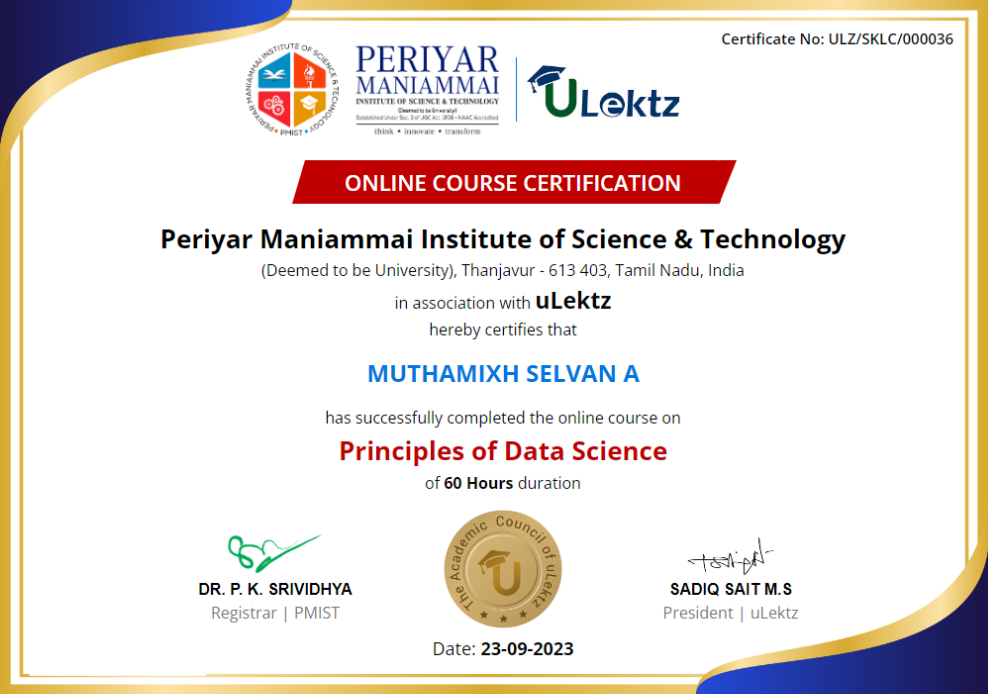
The certificate issued for the Course will have
Only the e-certificate will be made available. No Hard copies. The certificates issued by The Academic Council of uLektz. can be e-verifiable at www.ulektzskills.com/verify.

 75 hours Learning Content
 100% online Courses
 English Language
 Certifications
Recommended Courses
See more
 90 hours of Learning Content


90 hours of Learning Content
180 hours of Learning Content
90 hours of Learning Content
90 hours of Learning Content
90 hours of Learning Content


 0
0


 Course Enrollment